
Why Every Japanese Campsite Has a Sierra Cup.
Walk any campground in Japan on a Saturday morning and you will see it: a shallow metal cup with a looped wire handle, hanging from a belt loop, a tripod, a guyline. It is the sierra cup, and it is more Japanese than Californian now.
Where it came from
The shape is American. The Sierra Club in California sold a wide, shallow stainless cup with a wire handle to its members for decades. The wide mouth cools a drink, the shallow body sits on coals, and the handle keeps your fingers away from the rim and hooks the cup to whatever you are carrying. It came to Japan in the 1970s with the first wave of American backpacking culture: the frame packs, the magazines, the translated trail guides.
What Japan did with it
Japan kept the shape and changed the job. Rice here is measured in gō, 180 ml, and a Japanese sierra cup has lines inside it so a pot of rice can be measured beside the fire without a second tool. The cup became a unit. Then it became a system: deeper cups, lids, plates that nest, handles that fold, sizes that stack inside one another.
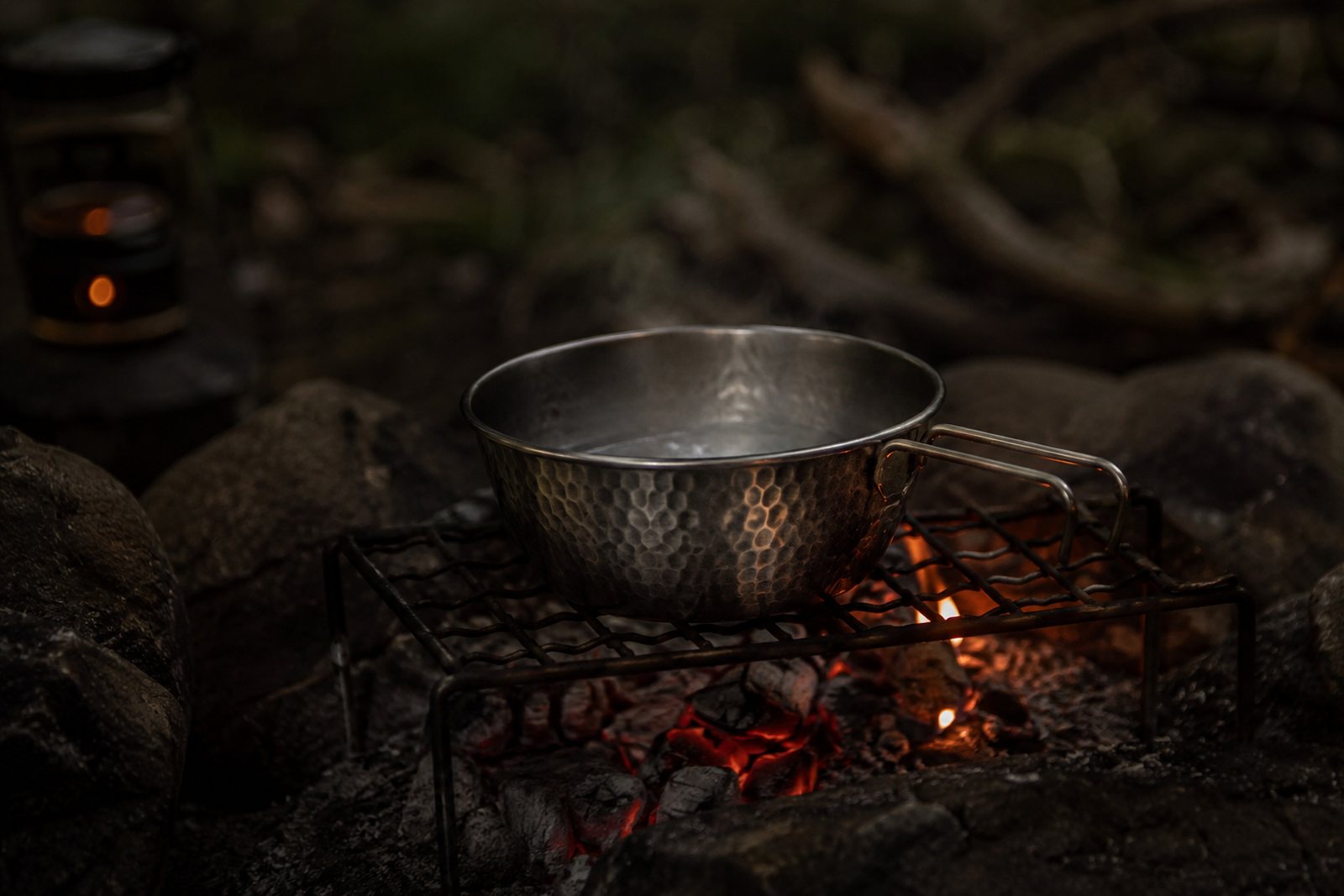
It is the first piece of gear most Japanese campers buy, and often the last one they replace. A steel one costs about the same as lunch. The titanium ones cost more, weigh half as much, and take on a color from the fire that people here treat as a kind of diary.
How it is used
- As a measure for rice and water.
- As a bowl for miso soup, which is most nights.
- As a ladle for the pot and a scoop for the stream.
- As a mug for coffee, tea, and the last of the whisky.
- Hung from the belt, which says, without saying it, I cook here.
Why the good ones come from one town
Tsubame-Sanjo, in Niigata, has made metal tableware for more than a century, and much of the world's stainless flatware for a good part of it. When titanium arrived as a material for camp cookware, the town already had the presses, the spinning lathes, and the hands that finish a rim so it does not cut a lip. The cup we carry is made there. It is light, it does not rust, it does not taste of anything, and after a season by the fire it is yours in a way a new one is not.
A cup. A measure. A place by the fire.
Related: Titanium Sierra Cup 480 · Titanium Craft · Field Notes: One Cup, Forty Nights