
Small Pitch, Big Fire. How Japan Camps.
Saturday, nine in the morning, a campground in the hills west of Tokyo. The gravel squares are already half full. A station wagon sits inside each one with a sand-colored tent beside it, a fire stand cooling from breakfast, a low table, two chairs that put your knees above your hips. Nobody is more than fifteen steps from the next tent, and nobody is loud. If you have camped in the United States, almost everything about this picture is slightly off. This is a note on why.
The pitch is a room
Most Japanese campgrounds sell a kukaku site: a marked plot, reserved in advance, with a number on a post. It is often eight to ten meters on a side, sometimes less. A "free site" here does not mean freedom to camp anywhere. It means freedom to choose your spot inside a designated field. An "auto site" means the car can come in and park beside the tent.
The American picture is wider. A developed campground gives you a parking spur, a picnic table, a fire ring and a toilet down the road. Beyond that lies dispersed camping on National Forest and other public land: no table, no ring, no water, no fee, and in most forests a limit of fourteen days in any thirty. A Japanese weekend can feel like renting a small outdoor room in a shared resort. An American one can feel like a low-service expedition you happened to drive to.
The room changes everything downstream. When neighbors are close, the size of your tent, the height of your voice, the brightness of your lantern and the way you handle fire all become manners.
Fire is lifted off the ground
The sharpest difference is the fire. At many Japanese campgrounds the rule is jikabi kinshi: no fire directly on dirt, grass, gravel or sand. You bring a takibidai, a fire stand, and increasingly a heat-resistant sheet to put under it so the ground is not scorched. Some sites spell it out in the rules: stand and sheet required.
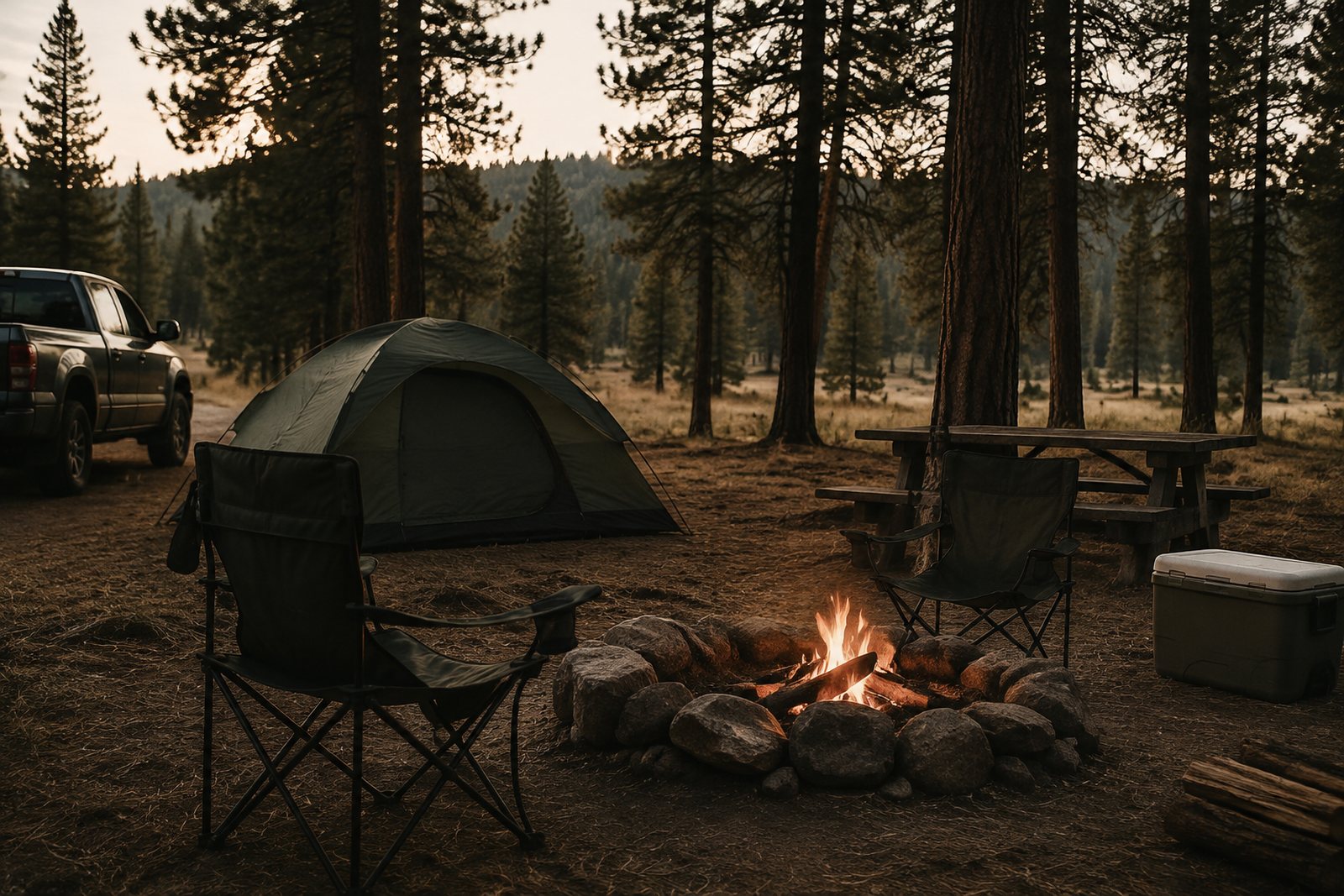
In the United States a developed site usually comes with a permanent metal ring, and the fire goes in it. In dispersed areas you use the ring somebody left, and in a dry summer you may not be allowed a wood fire at all. The instinct is the same, keep fire contained, but the tool is different. Americans inherit a ring. Japanese campers carry one.
That is why so much Japanese fire gear folds flat, weighs little, and stands on legs. A fire stand that packs like a paperback is not a novelty here. It is the thing that makes a fire legal.
Ten o'clock
Quiet hours exist on both sides of the Pacific. American campgrounds commonly post 10 p.m. to 6 a.m., and the National Park Service uses that range as its example. Japanese sites often say 22:00 to 07:00 and mean more by it: lower voices, dim the lantern, no music, finish cooking. One campground bans barbecue after 21:30. The unwritten part is stronger than the written part. By half past ten a Japanese campground is dark and nearly silent, with fifty fires burning low.
The American campground has a noise problem Japan barely knows: the generator. RV and trailer culture means parks write rules about when one may run. Glacier limits generators to three daytime windows. Japan's rules are about voices.
Check in at one, out by eleven
A Japanese campground runs like an inn. There is a reception desk, a check-in window, often 13:00 to 17:00, and a checkout around 10:00 or 11:00. Late arrival needs a phone call. Most trips are one night. The rhythm is fixed: arrive after lunch, pitch, cook early, fire, sleep, pack by mid-morning, and then, if there is one nearby, the hot spring. An onsen on the way home is not a treat. It is part of the plan.
American check-in is looser, often "after noon" with a self-registration board, and the stay can run from a night to a road trip of weeks. The Japanese version trades range for reliability. You know exactly what you are getting, and so does everyone around you.
Cooking at table height, living at knee height
Because the pitch is small and the car is right there, Japanese camp cooking is compact and table-centered: rice in a small pot, a skillet, a sierra cup that measures and then becomes the bowl, a Dutch oven on the fire stand, a hotpot in the cold months. The cooler is small. Shopping happens on the way, at the supermarket by the highway exit.
American car camping leans on volume: a large cooler, ice, a two-burner stove, a grill, food for the group. In bear country the cooler goes in the car at night or in a steel box, and a growing number of forests require canisters in the backcountry.
The chairs tell the same story. Japanese "low style" puts the seat close to the ground, the table at shin height, the fire at eye level when you sit. It suits a small pitch, a one-pole tent with a low door, and a fire you tend by hand. It also looks calm, which matters when fifty people can see your site.
Trash goes home
Many Japanese campgrounds have no bins. You separate your trash and take it home, or buy the designated bag and leave it at the collection point. American developed campgrounds usually have dumpsters. Dispersed sites have nothing, and "pack it out" is the whole rule, with food waste doubling as a wildlife problem. Different mechanics, same outcome expected: the site looks untouched when you leave.
What this does to the gear
Put the pieces together and the Japanese kit designs itself. A tent that pitches on a single pole in a small square, in a cotton blend that can sit near the fire without melting. A fire stand that folds flat because you carry the ring instead of finding one. A tarp that makes shade over a low table. Chairs that put you at the fire's height. A titanium cup that measures rice and then holds the soup. Gear that packs small because it goes in the back of a station wagon every other weekend, and gear that lasts because it is used that often.
None of it is better than the American kit. It is an answer to a different question: how do you make a good fire, a good meal and a good night on a square ten meters wide, with neighbors on three sides, and leave by eleven. The answer turned out to travel well.
Numbers, for scale: Kampgrounds of America counts more than 52 million North American households that camped in 2025. The Japan Auto Camping Federation's 2025 white paper puts the average Japanese camper at five trips a year, about 6.7 nights, at roughly ¥23,000 per trip. Rules quoted above are examples from individual campgrounds and park units. Check the site you are booking.
Related: TABI Titanium Fire Stand · Circus TC DX+ · The Tent That Became a Common Language · Why Every Japanese Campsite Has a Sierra Cup